
The cold hits you before you even get your bearings. Not the polite chill of a November morning in Michigan — the kind of cold that has actual intentions. Standing on the deck of the Akademik Ioffe somewhere in the Drake Passage, 35-knot winds coming from nowhere and everywhere at once, snow horizontal, the temperature sitting at 25°F, I remember thinking: I packed for this. I am definitely not dressed for this.
But let me back up, because getting to the bottom of the world is half the story.
The whole thing started with 2.5 hours of sleep. I’d finished packing at 4 a.m., had a 9 a.m. cortisone shot for a bursitis-wrecked hip, and was wheels-up out of Detroit by mid-morning. The first-class upgrade I was counting on between DTW and Miami got swiped by some guy with more airline status than me, which deposited me in an aisle seat next to what I can only describe as a middle-aged Mossad operative doing a budget Justin Timberlake cosplay — pot belly, receding hairline, gold-rimmed Ray-Ban aviators — who spent the entire flight elbowing me and hollering to his friends across the cabin. Not a crisis. I couldn’t sleep anyway.

Buenos Aires was a three-hour layover that became a customs adventure, because apparently connecting passengers still have to claim their bags and clear immigration. The massive duffel I’d brought — the same body-bag-sized thing that had ridden on my friend Gino’s back in Thailand — made its international reappearance. Then I walked right past my friend Lisa, decided she wasn’t there, found a seat overlooking the tarmac, and took a nap. Twenty years of friendship and I nearly ghosted her in Argentina. Classic. She found me anyway, introduced me to Nick and Amy, a great couple from New York, and then we discovered our connecting flight to Ushuaia was delayed two hours. There was only one reasonable response to that. I don’t often drink champagne at 9 in the morning, but when I do, it’s out of cheap plastic cups. #keepitclassyargentina.
Ushuaia — fin del monde , the end of the earth — earned that name the second I stepped off the plane. It’s a proper town wedged between the Beagle Channel and the mountains of Tierra del Fuego, and it operates as the last outpost before the continent that has no permanent human population. We stayed at the Hotel Albatros on Calle Maipu, a solid, no-nonsense place a short walk from the water, checked in, found our bearings over cold beers, and then sat down to a t-bone steak with Argentinian Malbec that was, without exaggeration, everything Argentinian beef is cracked up to be. By 3 p.m. the next afternoon we were boarding the ship.
“Excitement doesn’t quite do justice to the anticipation” — which is my way of admitting I was standing on the gangway of a 310-foot Russian research vessel like a kid on Christmas morning who’d been told Santa might also bring orcas.
The Akademik Ioffe , built in 1989 and still sailing under Russian flag, is not a luxury cruise ship. It’s a proper expedition vessel — comfortable, functional, crewed by some of the most knowledgeable guides I’ve encountered anywhere across 40-odd countries. Our cabin had two twin beds, an ensuite head, and a porthole. The upgrade to a slightly larger cabin is a story that involves Nick’s impossible quest to find a men’s size 12 hiking boot in Ushuaia and the three extra hours that search bought me to raid every camera store in town. Worth every minute — I got the cable I needed to connect Gino’s borrowed Nikon D200 to my tablet, plus a chocolate gelato that deserves its own entry.
The Drake Passage has a reputation. It mostly deserved it. We crossed the Antarctic Convergence — the invisible line where sub-Antarctic water meets the Southern Ocean — and the temperature dropped, the swell built, and half the 70 passengers aboard went horizontal for 24 hours. The ship’s motion didn’t bother me, which made me feel both grateful and guilty watching other people lose the battle. We picked up 35-knot winds and snow by day two, and I stood out on deck in it reading the Nikon manual, trying to get albatross shots, grinning like an idiot.
Then the South Shetland Islands appeared, and everything changed.
When You Actually Get There

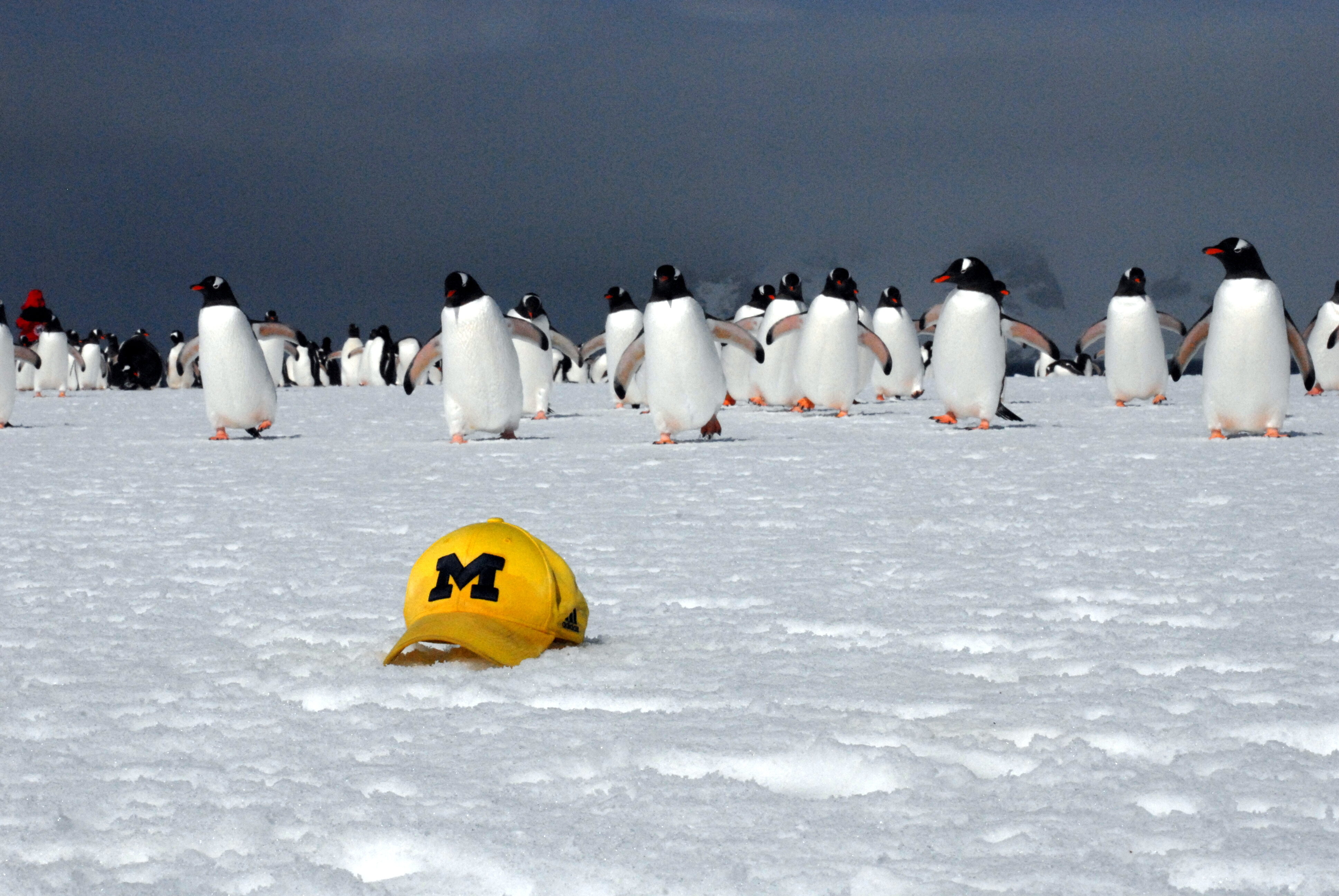
The morning we reached the islands, the weather broke clean and cold — crystal slate-blue water, iridescent white everywhere you looked, the kind of sky that makes you feel like you’re inside a photograph. Getting ready for the first kayak excursion required: fleece pants, running pants, two pairs of SmartWool socks, a base layer, a long-sleeve insulating shirt, a Musto vest, a warm beanie with my Michigan M-hat on top, then a trip to the mud room to pull on the dry suit, neoprene booties, PFD, and gloves. By the time I stepped onto the deck I was sweating from the waist down and breathing cold air from the collar up. It was, somehow, perfect.
We paddled past the gentoo penguin rookery, out to the ice fast where Weddell seals were parked on the floes like they’d been there since the Pleistocene, and along the shoreline where blue-white glaciers came straight down to the water. Arms-length from the ice. The silence between paddle strokes was absolute. My friend Lisa sat this first one out — the sea sickness hadn’t fully released her — and I thought about that as I paddled, how she’d come all this way and was watching from the ship while the rest of us floated among icebergs. She made the next one. Of course she did.
After the kayak, zodiacs to shore to walk among the penguins. Hundreds of gentoos at arm’s reach, completely indifferent to us, going about the serious business of hauling rocks to build nests, finding mates, and occasionally waddling into each other at speed. A couple of lone chinstraps mixed in, looking like they’d wandered in from a different party and decided to stay. It was nesting season, which meant — yes — we also witnessed penguin sex. Antarctica in November, folks. It’s not all icebergs.
That evening, Deception Island. Old post-WWII whaling hangers and collapsed structures giving the whole place the feel of a set from a disaster film that nobody cleaned up. Bleak in the best possible way. And then, in the middle of a snowstorm with 20-knot winds, someone announced the polar plunge. I stripped down to running shorts and the M-hat, sprinted across the black sand beach, and threw myself into the Southern Ocean. The cold is not something you process in real time — your brain just files a complaint and waits for you to do something about it. Scrambling back out, my fingers went numb so fast I needed help zipping my jacket and buckling my PFD for the two-minute zodiac ride back to the ship. I now have one ocean left. The Arctic, if you’re counting.
Paradise Bay came next, and the name — which does it zero justice — turned out to be the continent itself. Actual Antarctica. My seventh continent, checked off in 20°F sunshine with icebergs the size of apartment buildings drifting past the kayak, and a distant orca blowhole mist on the horizon that the morning group apparently got much closer to than I did. I’m choosing not to be bitter about this.

Here’s the thing about Antarctica that doesn’t translate to a trip report or a photo album: it is the only place I’ve ever been where the scale of what you’re looking at makes you feel genuinely, uncomplicatedly small. Not in an existential-crisis way. In a clarifying way. The continent has no permanent human population. No economy. No government worth mentioning. No cell signal, no Wi-Fi — just a satellite email portal shared among 70 passengers that made sending a blog post feel like a small miracle. It has existed for hundreds of millions of years and will continue existing long after every country that currently claims territorial interest in it has dissolved. You go there and you realize you’re a tourist in geological time, which is a feeling most travel can’t give you at any price.
The price, for the record, is significant. The Akademik Ioffe expedition runs through One Ocean Expeditions, and a berth is not cheap. But you’re also getting two days across the Drake, ten days of two-to-three excursions per day, an eight-day photography course with a working professional, dry suit kayaking, zodiac cruises through ice fields, and shore landings on the actual continent. Spread it out that way and the math starts to look different. Pack your cables. All of them. Don’t be me.
Antarctica doesn’t reward you with the thing you came for — the “experience,” the photo, the story. It just exists, on its own terms, completely without interest in whether you showed up. That’s what makes it worth the 2.5 hours of sleep, the cortisone shot, the guy on the Miami flight, the champagne from plastic cups, and every numb finger on the way back from that polar plunge. You went to the one place on earth that doesn’t care you’re there. Turns out that’s exactly what I needed.
Have questions about the logistics — which ship, what to pack, how to book kayaking vs. standard excursions, or whether the Drake Passage will actually destroy you? Drop them to the Ask WildWilliam AI — it’s got the full trip in its memory and can give you straight answers without the sales pitch.